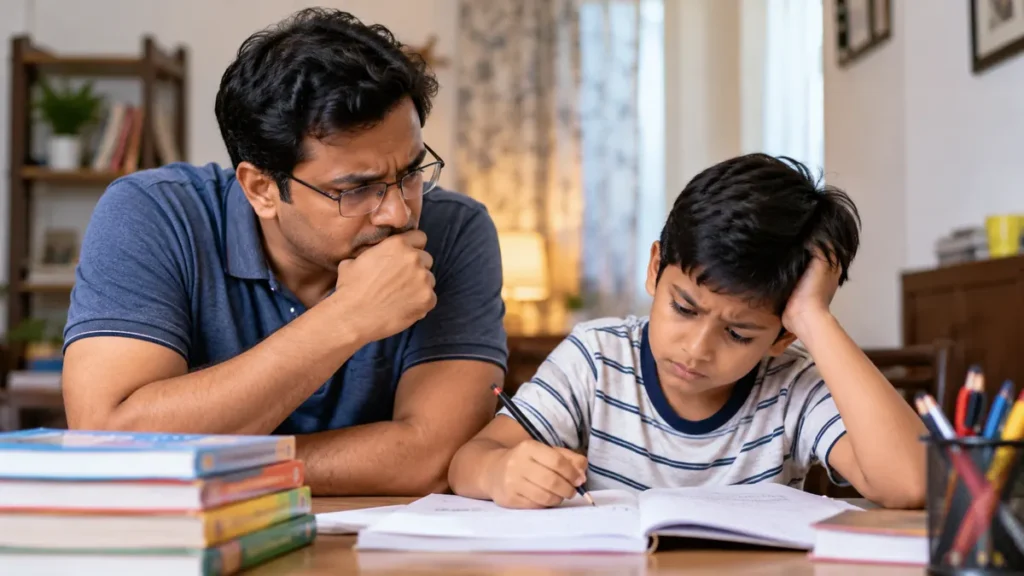
A few days ago, a father came to my institute to enquire about admission for his son. The boy is in Class 4.
During our conversation, he told me that the school keeps complaining about his son’s studies. Every few weeks, there is some problem or another, and the father is worried about how his son is doing.
As he was telling me all this, I could understand that he was looking for a solution. He wanted his son to study properly and do better in school, but things were not going the way he expected.
I kept thinking about that conversation afterwards.
I have seen many parents who are concerned about their children’s studies. Some children spend time with their books, complete their homework and attend tuition, but their performance in school still does not improve as expected. Naturally, parents start wondering what else they should do.
Should they increase the study hours? Should they change the tutor? Should they make the child practise more questions?
I don’t think we should jump to any of these decisions without first understanding the actual problem.
Let me explain what I mean.
Why a Child Is Struggling with Studies
Suppose a child is solving mathematics problems. The child may have learnt the steps for solving a particular type of question and may even get the answers right when practising from the same exercise. But when the teacher changes the question slightly in the examination, the child gets stuck.
Why does this happen?
In many cases, the child has learnt how to solve that particular question but has not fully understood the concept behind it. So, when the question looks different, the child doesn’t know how to proceed.
And this is not something that can always be solved by asking the child to practise another twenty questions in the same way.
First, we need to find out what the child has understood and what is still unclear.
This is one reason I believe that simply completing the syllabus is not enough. A teacher also needs to check whether the student can explain a concept, solve a question independently and apply what has been learnt to a different problem.
Regular tests are useful for this purpose, but only if we pay attention to the mistakes students make. If a child gets a question wrong, we should try to understand why. Was the basic concept unclear? Did the child make a calculation mistake? Or was the question not understood properly?
These are different problems, and they need different solutions.
Parents can try something similar at home. After a child finishes studying a chapter, ask them to explain what they have learnt. You don’t need to teach the chapter again or ask difficult questions. Just let the child explain it in their own words. You can also give them one or two similar questions to solve without looking at the book.
You may discover that the child understands the lesson quite well but makes careless mistakes. Or you may find that the child has memorised the answers without understanding the topic properly.
Both situations need attention, but the way we handle them will be different.
I also feel that we should give children enough time to understand things. Not every student learns at the same speed. If a child needs another explanation, that doesn’t necessarily mean the child is weak. Sometimes, the explanation needs to be changed, or the child needs a few more examples before the concept becomes clear.
Coming back to the father who visited my institute, I cannot say that I know exactly what his son needs just from that first conversation. I would need to understand the child’s difficulties before reaching any conclusion.
But his visit reminded me of something I often think about: when a child is struggling with studies, we should not look only at the marks or the complaints coming from school. We should try to understand what is happening when the child actually sits down to learn.
As a teacher, I believe that is where we need to begin.
If your child is studying in Class 9, you can also visit our [Study Materials] page to access our available practice paper.
Because before asking a child to study more, we should first find out whether the child is understanding what they are studying.